
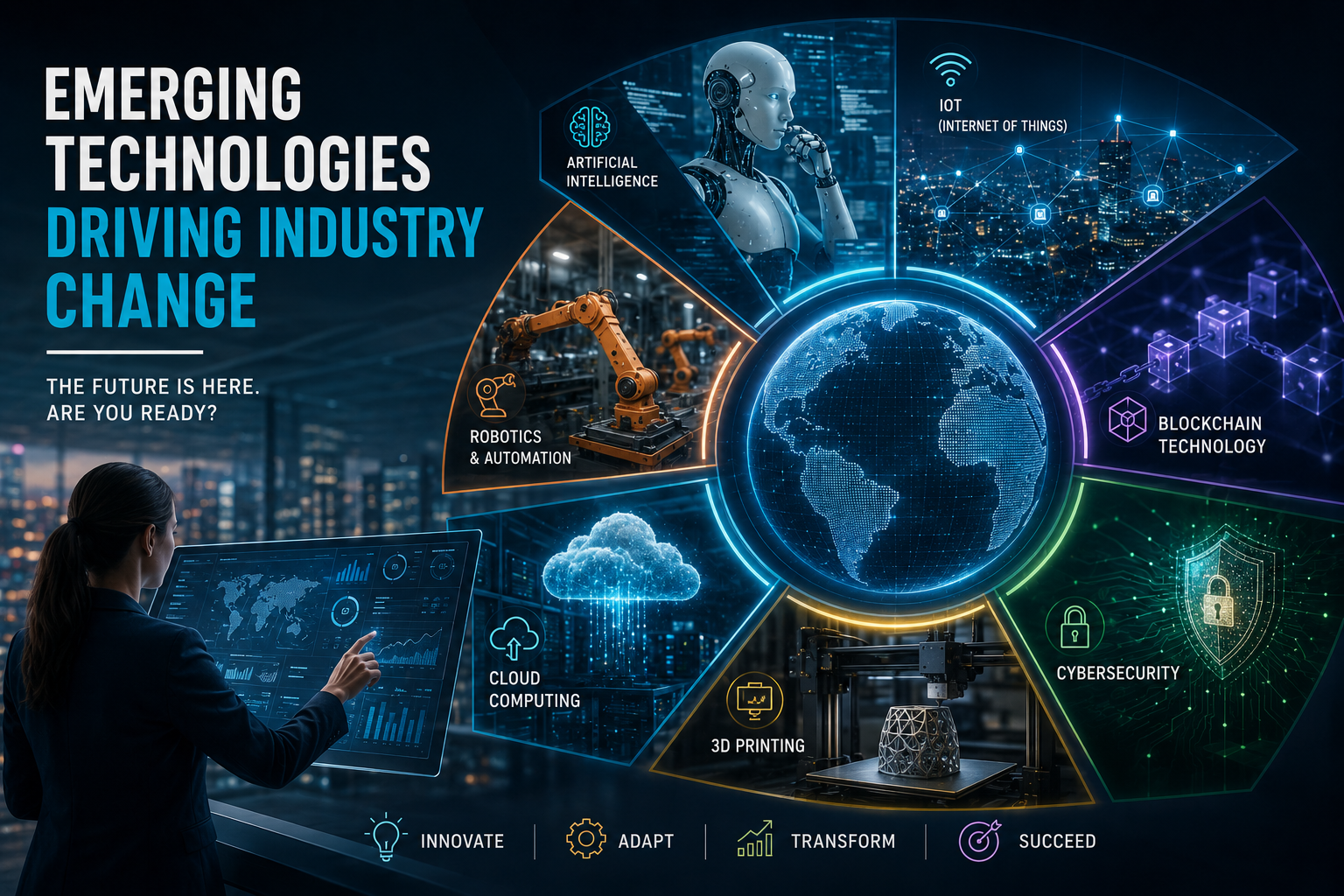
Explore how Emerging Technologies are transforming industries through AI, automation, blockchain, robotics, IoT, and advanced digital innovation.
Emerging Technologies Driving Industry Change
Technology continues to reshape industries at an unprecedented pace, creating new opportunities for businesses while transforming the way organizations operate. From artificial intelligence to advanced robotics, Emerging Technologies are improving productivity, enhancing customer experiences, and driving innovation across every major sector. Businesses that embrace these advancements are better prepared to remain competitive in today’s rapidly evolving global economy.
Artificial Intelligence Revolutionizes Business
Artificial intelligence (AI) has become one of the most influential Emerging Technologies in recent years. Companies use AI to automate repetitive tasks, analyze large datasets, improve customer support through intelligent chatbots, and make more informed business decisions.
Machine learning also enables businesses to predict customer behavior, personalize services, and improve operational efficiency across multiple departments.
Automation Improves Productivity
Automation helps organizations reduce manual work while increasing accuracy and efficiency. Businesses are implementing automated systems for manufacturing, customer service, inventory management, accounting, and marketing.
By automating routine processes, employees can focus on strategic activities that contribute more directly to business growth.
Internet of Things Connects Everything
The Internet of Things (IoT) allows physical devices to communicate through the internet. Smart sensors, connected equipment, wearable devices, and intelligent appliances collect real-time information that helps businesses monitor operations more effectively.
Industries such as healthcare, logistics, agriculture, and manufacturing increasingly rely on IoT to improve performance and reduce operational costs.
Cloud Computing Supports Digital Growth
Cloud computing enables businesses to access software, data storage, and computing resources without maintaining expensive physical infrastructure.
Organizations benefit from greater flexibility, improved collaboration, stronger data accessibility, and easier scalability as their operations expand.
Blockchain Enhances Security
Blockchain technology provides secure, transparent, and decentralized record-keeping systems. Although commonly associated with cryptocurrencies, blockchain has applications in supply chain management, financial services, healthcare, digital identity verification, and contract management.
Its ability to increase transparency and reduce fraud makes it one of today’s most promising Emerging Technologies.
Robotics Transforms Manufacturing
Modern robotics improves production speed, workplace safety, and manufacturing precision. Robots perform repetitive, hazardous, and highly accurate tasks that improve product quality while reducing operational expenses.
Beyond manufacturing, robotics is expanding into healthcare, warehousing, hospitality, and logistics.
5G Expands Connectivity
The rollout of 5G networks enables faster internet speeds, lower latency, and improved connectivity for businesses and consumers.
High-speed communication supports autonomous vehicles, smart cities, remote healthcare, industrial automation, and advanced IoT applications that require real-time data transmission.
Cybersecurity Innovation
As businesses adopt more digital technologies, cybersecurity becomes increasingly important. Advanced security systems powered by artificial intelligence help detect threats, monitor unusual activity, and respond to cyberattacks more quickly.
Protecting sensitive information remains essential for maintaining customer trust and business continuity.
Extended Reality Enhances User Experiences
Virtual reality (VR), augmented reality (AR), and mixed reality (MR) are changing how businesses train employees, market products, and engage customers.
Retailers offer virtual product demonstrations, healthcare providers conduct immersive training, and educational institutions create interactive learning environments using extended reality technologies.
Green Technology Supports Sustainability
Sustainable innovation has become a major priority across industries. Renewable energy systems, energy-efficient manufacturing, electric vehicles, and smart environmental monitoring technologies help organizations reduce their environmental impact while improving long-term operational efficiency.
Green innovation also strengthens corporate responsibility and meets growing consumer demand for sustainable business practices.
Preparing for the Future
Organizations that invest in learning, employee training, and technology adoption are better positioned to benefit from future innovations. Monitoring industry developments and implementing new solutions strategically helps businesses remain adaptable as technology continues to evolve.
Adopting Emerging Technologies is no longer optional for many businesses—it is becoming essential for maintaining competitiveness in a rapidly changing marketplace.
Conclusion
Emerging Technologies are transforming industries by improving efficiency, enhancing security, increasing connectivity, and creating new business opportunities. Artificial intelligence, automation, IoT, cloud computing, blockchain, robotics, and sustainable innovations are reshaping how organizations operate worldwide. Businesses that embrace these technological advancements today will be better equipped to succeed in the digital economy of tomorrow.
FAQs
1. What are Emerging Technologies?
Emerging Technologies are innovative technologies that are rapidly developing and transforming industries through new capabilities and improved efficiency.
2. Why are Emerging Technologies important?
They help businesses increase productivity, reduce costs, improve customer experiences, and remain competitive in changing markets.
3. Which industries benefit most from Emerging Technologies?
Manufacturing, healthcare, finance, retail, logistics, agriculture, education, and transportation all benefit from technological innovation.
4. How does artificial intelligence support businesses?
AI automates repetitive tasks, analyzes data, improves customer service, enhances decision-making, and increases operational efficiency.
5. How can businesses prepare for Emerging Technologies?
Businesses should invest in employee training, adopt digital tools, strengthen cybersecurity, monitor industry developments, and implement technology solutions that align with their long-term goals.
