
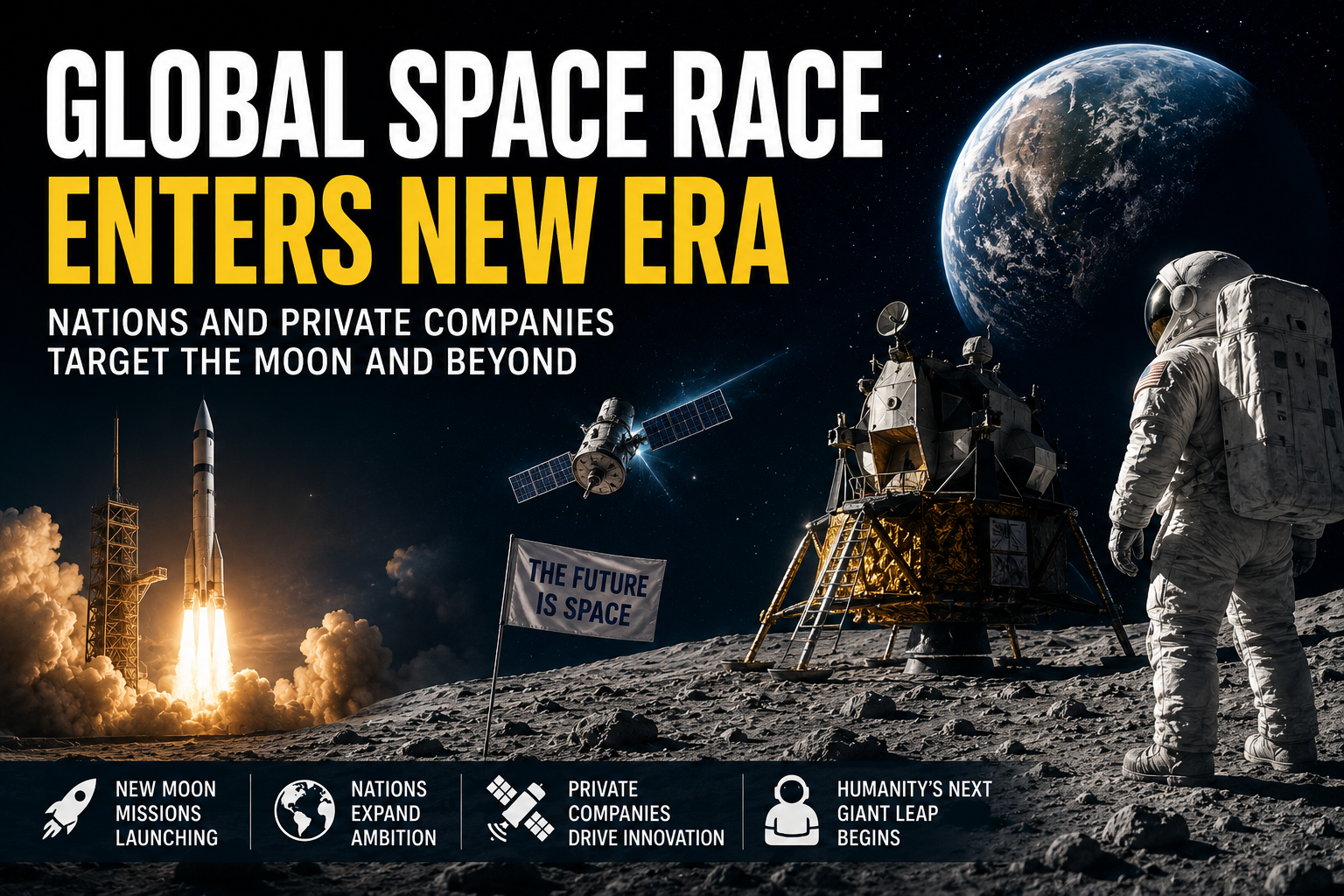
The global competition for space exploration is entering a new era as governments and private companies accelerate plans for lunar missions, advanced satellites, reusable spacecraft and future human exploration beyond Earth.
Unlike the space race of the twentieth century, which was dominated primarily by competition between the United States and Soviet Union, today’s space sector includes a much larger group of participants.
The United States, China, India, Japan and European countries are expanding their ambitions, while private companies are developing rockets, spacecraft and technologies that could dramatically reduce the cost of reaching orbit.
At the centre of much of this activity is the Moon.
After decades in which human exploration focused primarily on low-Earth orbit, governments increasingly see the lunar surface as the next major destination for scientific research and long-term space development.
The Moon Returns to the Centre of Space Exploration
Humans last walked on the Moon during NASA’s Apollo 17 mission in December 1972.
More than five decades later, the objective is no longer simply to repeat the Apollo missions.
Modern lunar programmes are exploring whether humans can establish a more sustainable presence around and eventually on the Moon.
NASA’s Artemis programme is central to the United States’ strategy.
The programme is intended to return astronauts to the lunar environment while developing technologies and experience that could eventually support missions farther into the solar system.
China is pursuing its own increasingly ambitious lunar programme, while other nations are contributing spacecraft, scientific instruments and technology.
This growing international activity has made the Moon one of the most strategically important destinations in modern space exploration.
Why the Moon Matters
The Moon offers scientists an opportunity to study the early history of the solar system.
Because it lacks Earth’s active weather systems and geological processes, parts of its surface preserve evidence dating back billions of years.
Scientists are particularly interested in the lunar south polar region.
Research and previous missions have provided evidence that water ice exists in permanently shadowed areas near the poles.
Water could become extremely valuable for future exploration.
It could potentially provide drinking water for astronauts and, if separated into hydrogen and oxygen, contribute to the production of fuel and breathable oxygen.
That possibility has helped transform the Moon from a destination for short scientific visits into a potential base for longer-term exploration.
China Expands Its Space Ambitions
China has emerged as one of the world’s leading space powers.
Its Chang’e lunar missions have achieved several major milestones and demonstrated increasingly sophisticated capabilities.
China has also built the Tiangong space station, giving the country a permanent human presence in low-Earth orbit.
Future Chinese plans include additional lunar exploration and preparations for crewed missions to the Moon.
The rapid progress of China’s space programme has attracted close international attention.
For other space powers, particularly the United States, China’s achievements have added a strategic dimension to lunar exploration.
However, competition does not eliminate the possibility of scientific cooperation.
Space exploration has historically combined national competition with international partnerships, and that balance is likely to continue.
India Becomes an Increasingly Important Space Power
India has also strengthened its position in the global space sector.
The successful Chandrayaan-3 mission demonstrated India’s ability to achieve a controlled lunar landing and significantly raised the international profile of the Indian Space Research Organisation.
India’s space programme has become known for pursuing ambitious missions while maintaining comparatively controlled costs.
Beyond lunar exploration, India has worked on solar research, satellite launches and preparations for future human spaceflight.
The growth of India’s capabilities shows how the modern space race differs from the Cold War era.
Space is no longer dominated by only two superpowers.
A growing number of nations now possess advanced launch vehicles, satellites and scientific spacecraft.
Private Companies Transform the Industry
Perhaps the biggest difference between today’s space industry and earlier eras is the role of private companies.
Government agencies once designed, built and operated almost every major spacecraft.
That model has changed dramatically.
Commercial companies now develop launch vehicles, transport cargo, operate satellite networks and build spacecraft for government missions.
Reusable rockets have been particularly important.
Historically, most launch vehicles were used once and discarded.
Reusable systems allow expensive rocket components to return to Earth and potentially fly again.
This can significantly reduce the cost of launching payloads into space.
Lower launch costs create opportunities for more scientific missions, commercial satellites and potentially future space tourism.
SpaceX Remains a Major Player
SpaceX has played a significant role in reshaping expectations around rocket reusability and commercial spaceflight.
Its Falcon rockets have become widely used for satellite launches and missions supporting the International Space Station.
The company’s much larger Starship system is being developed with ambitions that extend well beyond Earth orbit.
Starship is intended to carry large payloads and potentially humans to destinations including the Moon and Mars.
Developing such a system is technically difficult, and testing large new rockets can involve setbacks.
However, progress in reusable heavy-lift spacecraft could have enormous implications for future exploration.
A vehicle capable of transporting large amounts of equipment into space at lower cost could change how scientists and engineers design missions.
Satellites Become Critical Infrastructure
The space race is not only about astronauts and lunar missions.
Satellites have become essential to modern civilisation.
Navigation, weather forecasting, television, communications, agriculture, financial systems and disaster management all depend heavily on space-based infrastructure.
Satellite internet networks are also expanding.
Large constellations of satellites can provide connectivity to areas where traditional telecommunications infrastructure is limited.
This has created new commercial opportunities but also new concerns.
Astronomers have warned that large numbers of satellites can interfere with observations of the night sky.
Space agencies are also increasingly concerned about orbital debris.
Space Debris Creates a Growing Problem
Thousands of active satellites now orbit Earth alongside old spacecraft, discarded rocket stages and fragments from previous collisions.
Even a small object can cause serious damage when travelling at orbital speeds.
As more satellites are launched, managing this environment becomes increasingly important.
Governments and companies are exploring technologies for tracking objects, avoiding collisions and potentially removing debris from orbit.
Without effective management, certain orbital regions could become increasingly dangerous.
This demonstrates that the future of space exploration will require regulation as well as technological innovation.
Artificial Intelligence Could Help Explore Space
Artificial intelligence is also becoming increasingly relevant to space missions.
Spacecraft operating far from Earth cannot always wait for instructions from human controllers.
Communication delays can make real-time control impossible.
More capable autonomous systems could allow spacecraft to analyse their surroundings, identify scientific targets and respond to unexpected situations independently.
AI can also help scientists process enormous quantities of data collected by telescopes and satellites.
As missions become more complex, the combination of robotics and artificial intelligence could allow humanity to explore environments that are too distant or dangerous for astronauts.
Mars Remains the Long-Term Prize
Although the Moon currently receives much of the attention, Mars remains one of humanity’s biggest exploration goals.
Robotic spacecraft have studied the planet for decades.
Rovers have examined Martian rocks, searched for evidence of ancient environments and helped scientists understand whether the planet may once have supported conditions suitable for life.
Sending humans to Mars would be far more difficult.
A crew would face radiation, isolation, limited supplies and a journey lasting months.
Returning safely would add another layer of complexity.
For this reason, many experts see lunar exploration as an important testing ground.
Technologies developed for living and working on the Moon could eventually help prepare astronauts for longer missions.
A New Economic Frontier
Space is increasingly becoming an economic sector as well as a scientific one.
Private investment is flowing into satellite communications, launch services, Earth observation and spacecraft technology.
Some companies are also studying future opportunities involving lunar resources and manufacturing in microgravity.
Many of these concepts remain experimental.
However, the rapid growth of commercial space activity suggests that the economic importance of orbit will continue increasing.
Governments are therefore considering not only scientific goals but also strategic and commercial interests.
The Next Decade Could Transform Space Exploration
The coming years could determine the direction of human space exploration for decades.
If current programmes succeed, astronauts could once again operate around the Moon while robotic missions continue exploring Mars and other parts of the solar system.
Reusable rockets could make launches more frequent.
Commercial space stations could eventually supplement or replace some government-operated infrastructure in low-Earth orbit.
Meanwhile, advances in robotics and artificial intelligence could expand the reach of unmanned exploration.
Many technical, financial and political challenges remain.
Space exploration is expensive, dangerous and unpredictable.
But the level of global investment demonstrates that governments and businesses increasingly believe space will play an important role in humanity’s future.
More than half a century after the first Moon landing, a new space race is taking shape.
This time, the objective is not simply to plant a flag.
The larger goal is to determine who can build the technology, infrastructure and partnerships needed to operate beyond Earth for the long term.
And if today’s plans succeed, the next chapter of human exploration could extend from Earth’s orbit to the Moon—and eventually much farther.
