
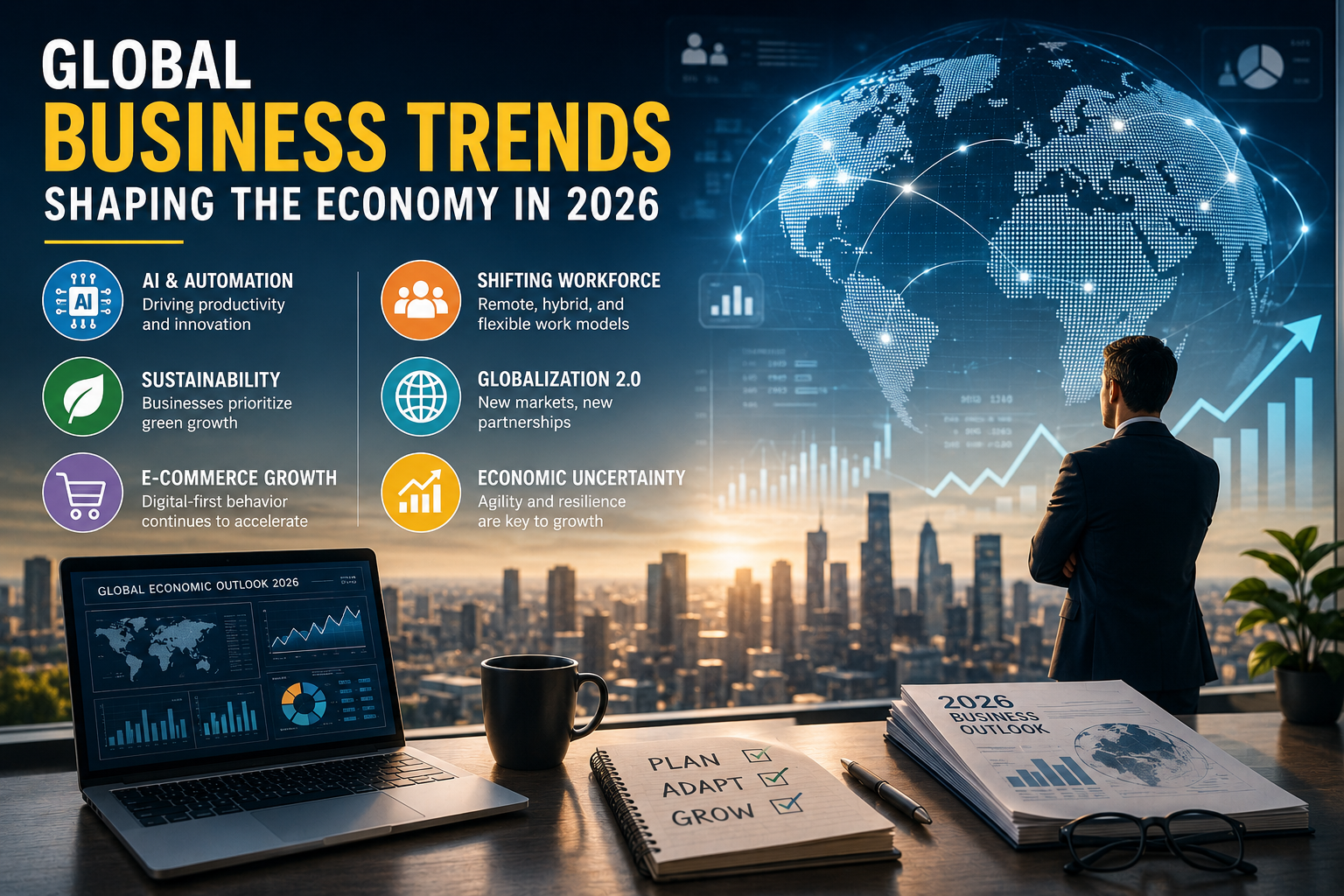
Explore the leading Global Business Trends shaping the economy in 2026, from AI and digital transformation to sustainability and global trade.
Global Business Trends Shaping the Economy in 2026
The global economy continues to evolve as businesses respond to technological innovation, shifting consumer expectations, and changing economic conditions. Companies that recognize emerging Global Business Trends are better positioned to remain competitive, improve efficiency, and discover new growth opportunities. In 2026, organizations across industries are focusing on innovation, resilience, and long-term sustainability to navigate an increasingly dynamic marketplace.
Artificial Intelligence Becomes a Business Standard
Artificial intelligence (AI) is no longer limited to large technology companies. Businesses of all sizes are using AI to automate repetitive tasks, improve customer service, analyze data, and support decision-making.
From intelligent chatbots to predictive analytics and workflow automation, AI continues to increase productivity while helping companies reduce operational costs.
Digital Transformation Continues
One of the most significant Global Business Trends is the ongoing shift toward digital operations. Cloud computing, digital collaboration platforms, and automation software allow businesses to work more efficiently while serving customers across multiple channels.
Organizations investing in digital transformation are improving operational flexibility and responding more quickly to changing market demands.
Sustainability Drives Business Decisions
Environmental responsibility has become a key business priority. Consumers, investors, and governments increasingly expect companies to reduce carbon emissions, minimize waste, and adopt sustainable business practices.
Businesses that integrate sustainability into their operations often strengthen their reputation while improving long-term resilience.
Hybrid and Remote Work Remains Strong
Flexible work arrangements continue to reshape the modern workplace. Many businesses now combine remote and office-based work to improve employee satisfaction and attract skilled professionals.
Companies are investing in collaboration tools, cybersecurity, and digital communication systems to support productive hybrid work environments.
Cybersecurity Investment Increases
As businesses rely more heavily on digital systems, cybersecurity has become essential. Organizations are strengthening their security infrastructure to protect customer data, financial information, and business operations from cyber threats.
Regular security training and advanced protection technologies are now considered standard business investments.
Data-Driven Decision Making
Businesses increasingly rely on real-time data to guide strategic decisions. Analytics platforms help organizations understand customer behavior, monitor market trends, and identify opportunities for improvement.
Companies that effectively use business intelligence gain a stronger competitive advantage in rapidly changing markets.
Supply Chain Diversification
Recent global disruptions have encouraged businesses to diversify suppliers and strengthen supply chain resilience. Instead of depending on a single source, many companies are expanding supplier networks and improving inventory management.
This strategy helps reduce risks associated with economic uncertainty and logistical challenges.
Expansion of Digital Commerce
E-commerce continues to grow across global markets. Businesses are improving online shopping experiences, integrating multiple payment options, and expanding into international markets through digital platforms.
Consumers increasingly expect fast delivery, secure transactions, and personalized shopping experiences.
Employee Well-Being and Talent Development
Companies recognize that long-term success depends on skilled and motivated employees. Businesses are investing in professional development, workplace wellness, leadership training, and flexible work policies.
Supporting employee growth improves retention, productivity, and overall organizational performance.
Innovation Through Collaboration
Partnerships between startups, established companies, universities, and technology providers are becoming more common. Collaborative innovation enables businesses to develop new products, enter new markets, and solve complex challenges more efficiently.
Strategic partnerships are expected to remain one of the leading Global Business Trends throughout 2026.
Adapting to Changing Consumer Expectations
Modern consumers value convenience, personalization, transparency, and excellent customer service. Businesses are using customer feedback and advanced analytics to deliver more personalized experiences while strengthening brand loyalty.
Organizations that adapt quickly to evolving customer preferences are better positioned for sustainable growth.
Conclusion
The leading Global Business Trends shaping the economy in 2026 reflect a business environment driven by technology, sustainability, innovation, and adaptability. Companies that embrace artificial intelligence, digital transformation, cybersecurity, employee development, and customer-focused strategies will be better prepared to compete in an increasingly connected global marketplace. By staying informed and responding proactively to these trends, businesses can build resilience and achieve long-term success.
FAQs
1. What are Global Business Trends?
Global Business Trends are major developments that influence how businesses operate, compete, and grow across international markets.
2. Why are Global Business Trends important?
They help businesses identify new opportunities, manage risks, improve competitiveness, and prepare for future market changes.
3. How is artificial intelligence affecting businesses in 2026?
AI improves productivity by automating tasks, enhancing customer service, supporting data analysis, and streamlining business operations.
4. Why is sustainability becoming a major business trend?
Consumers, investors, and regulators increasingly expect businesses to adopt environmentally responsible practices that support long-term growth.
5. How can businesses prepare for future Global Business Trends?
Businesses should invest in technology, monitor market developments, strengthen cybersecurity, support employee development, and remain flexible as customer needs and economic conditions evolve.
