
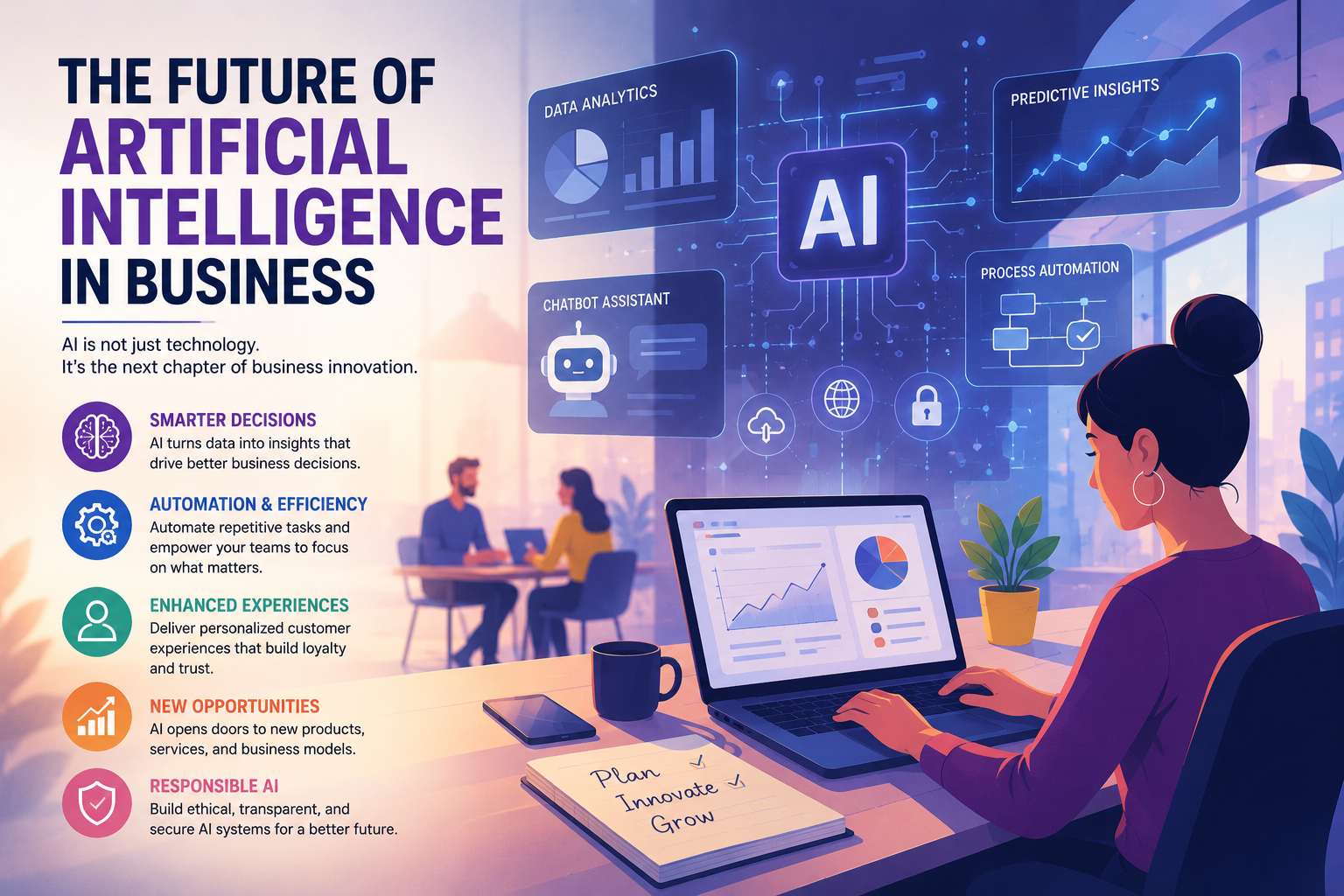
Explore the AI Future in business and discover how artificial intelligence is transforming operations, customer experiences, and decision-making.
The Future of Artificial Intelligence in Business
Artificial intelligence has evolved from an emerging technology into a core part of modern business operations. Organizations across industries are using AI to improve efficiency, enhance customer experiences, and make better decisions based on real-time data. As technology continues to advance, the AI Future promises even greater opportunities for businesses that are ready to embrace innovation.
From small startups to global enterprises, artificial intelligence is reshaping the way companies operate and compete in an increasingly digital economy.
AI Becomes a Strategic Business Tool
The AI Future goes beyond automating simple tasks. Businesses are increasingly integrating AI into strategic planning, forecasting, and decision-making. Advanced algorithms analyze large amounts of data to identify trends, predict customer behavior, and support faster, more informed business decisions.
Organizations that use AI effectively gain valuable insights that improve competitiveness and long-term planning.
Smarter Customer Experiences
Artificial intelligence is transforming customer service through intelligent chatbots, virtual assistants, and personalized recommendations. AI systems can answer customer questions, resolve common issues, and provide support around the clock.
Businesses also use AI to personalize marketing campaigns, recommend products, and create tailored customer experiences that improve satisfaction and loyalty.
Increased Automation
Automation will continue to expand as AI becomes more capable. Repetitive administrative tasks, inventory management, document processing, scheduling, and workflow management can all be handled more efficiently through intelligent automation.
This allows employees to focus on creative problem-solving, strategic planning, and relationship-building instead of routine manual work.
Better Business Decisions
Modern AI systems analyze historical and real-time data much faster than traditional methods. Businesses use predictive analytics to forecast sales, optimize inventory, manage financial risks, and improve operational planning.
The AI Future will make decision-making increasingly data-driven, reducing uncertainty and improving business performance.
AI Supports Every Department
Artificial intelligence is no longer limited to information technology teams. Marketing departments use AI for customer segmentation and campaign optimization, finance teams automate reporting and fraud detection, human resources improve recruitment processes, and operations teams optimize supply chains.
This broad adoption makes AI a valuable resource across the entire organization.
Cybersecurity Becomes More Intelligent
As cyber threats become more advanced, AI-powered security systems help businesses detect unusual activity, identify potential attacks, and respond to threats more quickly.
Machine learning continuously improves cybersecurity by recognizing patterns and adapting to new attack methods, helping organizations protect valuable business data.
Human and AI Collaboration
The future of AI is centered on collaboration rather than replacement. AI handles repetitive analysis and routine tasks while employees contribute creativity, leadership, emotional intelligence, and strategic thinking.
Businesses that combine human expertise with AI capabilities often achieve better results than relying on either alone.
Ethical and Responsible AI
As AI becomes more widespread, organizations are placing greater emphasis on responsible development and ethical use. Businesses are working to ensure transparency, fairness, data privacy, and accountability when implementing AI solutions.
Responsible AI practices strengthen customer trust and support long-term business success.
Preparing Employees for the AI Future
Businesses are investing in employee training to help teams work effectively with AI technologies. Developing digital skills, analytical thinking, and adaptability prepares employees for changing workplace requirements.
Continuous learning will become increasingly important as AI capabilities continue to evolve.
Long-Term Business Growth
Companies that embrace the AI Future can improve productivity, reduce operational costs, accelerate innovation, and respond more quickly to market changes. AI enables businesses to scale efficiently while delivering higher-quality products and services.
Organizations that adopt AI strategically today are likely to gain a significant competitive advantage in the years ahead.
Conclusion
The AI Future is transforming business by improving automation, enhancing customer experiences, supporting smarter decision-making, and driving innovation across every industry. While challenges such as ethics, privacy, and workforce adaptation remain important, artificial intelligence offers tremendous opportunities for organizations willing to invest in responsible implementation. Businesses that embrace AI today will be better positioned to compete, innovate, and achieve sustainable growth in the digital economy.
FAQs
1. What does AI Future mean in business?
AI Future refers to the growing role of artificial intelligence in improving business operations, decision-making, automation, and customer experiences.
2. How is AI changing businesses?
AI helps businesses automate repetitive tasks, analyze data, personalize customer interactions, improve security, and increase operational efficiency.
3. Will AI replace human workers?
AI is more likely to automate routine tasks while allowing employees to focus on creative thinking, leadership, problem-solving, and relationship management.
4. Which industries benefit most from AI?
Healthcare, finance, retail, manufacturing, logistics, education, marketing, and customer service are among the industries benefiting significantly from AI technologies.
5. How can businesses prepare for the AI Future?
Businesses should invest in AI technologies, train employees, strengthen data security, develop ethical AI policies, and continuously monitor technological advancements to remain competitive.
