
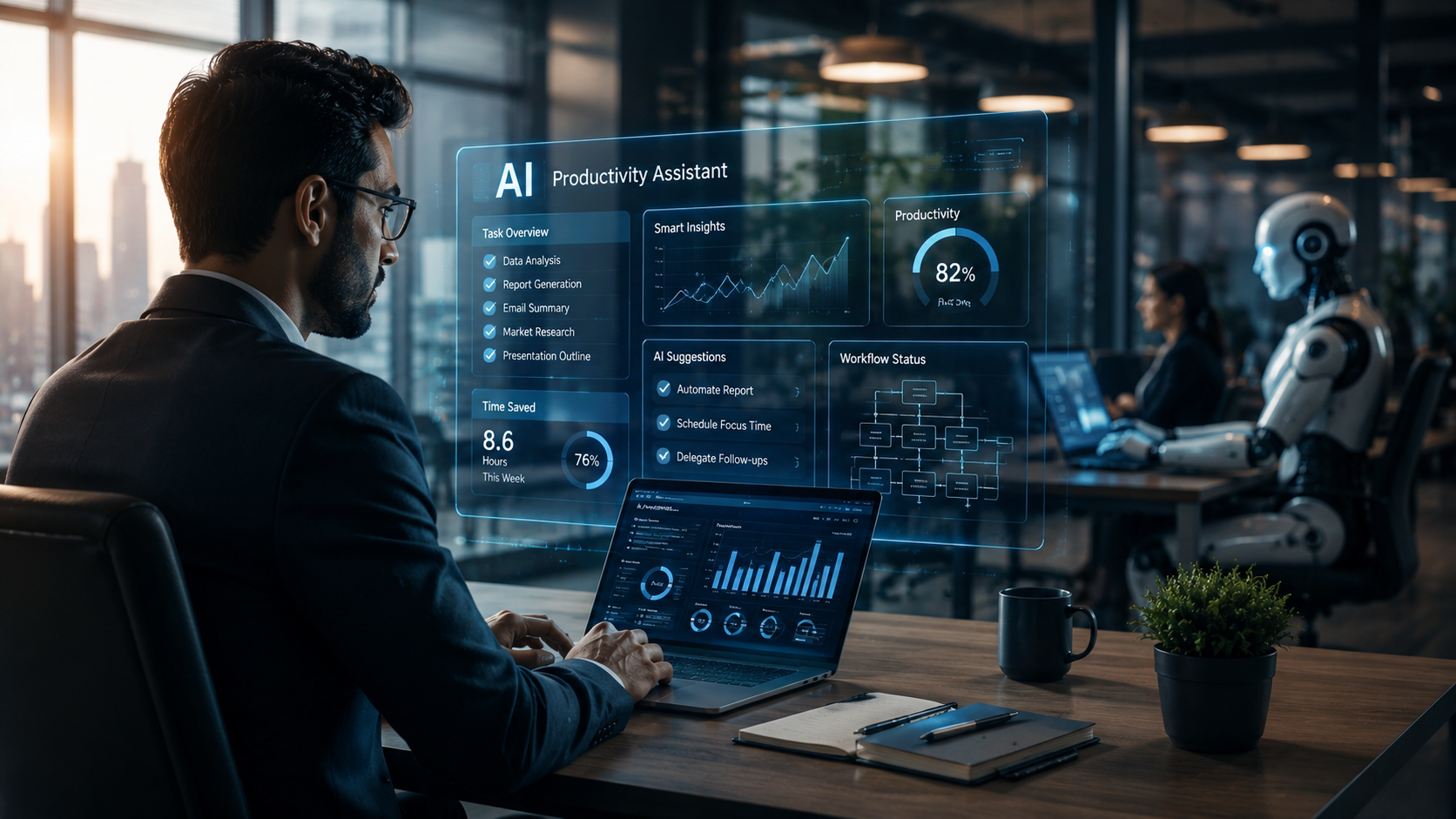
Discover how AI Productivity tools help businesses automate tasks, improve efficiency, enhance decision-making, and support sustainable growth.
The Role of Artificial Intelligence in Productivity
Artificial intelligence has become one of the most transformative technologies in the modern workplace. Organizations across industries are using AI to automate repetitive tasks, improve decision-making, and increase operational efficiency. As technology continues to evolve, AI Productivity is becoming a key factor in helping businesses remain competitive and adapt to changing market demands.
Rather than replacing human expertise, artificial intelligence is increasingly serving as a powerful tool that enhances employee performance and supports smarter business operations.
Understanding AI Productivity
AI Productivity refers to the use of artificial intelligence technologies to improve efficiency, reduce manual work, and optimize business processes. AI systems analyze data, identify patterns, automate routine activities, and provide insights that help employees make better decisions.
By handling repetitive tasks, AI allows teams to focus on creativity, strategy, and customer engagement.
Automating Repetitive Tasks
Many organizations spend significant time on routine administrative work such as data entry, scheduling, invoice processing, and document management.
AI-powered automation completes these tasks quickly and accurately, reducing errors while allowing employees to dedicate more time to high-value responsibilities.
Improving Decision-Making
Artificial intelligence can process large volumes of information far faster than traditional methods. AI analyzes historical data, identifies trends, and generates insights that support strategic planning.
Business leaders can use these insights to improve forecasting, manage risks, and make more informed operational decisions.
Enhancing Customer Service
AI-powered virtual assistants and intelligent chatbots provide customers with fast responses to common questions at any time of day.
These systems improve customer satisfaction by reducing response times while enabling human support teams to focus on more complex inquiries.
Supporting Workplace Collaboration
Modern AI tools assist employees by organizing information, summarizing documents, managing calendars, and recommending actions based on ongoing projects.
These capabilities improve communication, streamline workflows, and enhance collaboration across departments.
Increasing Operational Efficiency
Businesses are integrating AI into supply chain management, inventory control, financial reporting, and production planning.
By analyzing real-time operational data, AI helps organizations optimize resources, reduce waste, and improve overall productivity.
Personalizing Marketing and Sales
Artificial intelligence enables businesses to better understand customer behavior through advanced analytics.
Organizations can create personalized marketing campaigns, recommend products based on customer preferences, and improve sales forecasting using AI-powered insights.
Strengthening Cybersecurity
AI plays an increasingly important role in identifying unusual network activity, detecting potential threats, and responding to cybersecurity incidents.
Automated monitoring allows businesses to improve security while minimizing disruption to daily operations.
Empowering Employees
One of the greatest advantages of AI Productivity is its ability to support employees rather than replace them.
AI handles repetitive and time-consuming work while professionals contribute critical thinking, creativity, leadership, and relationship-building skills that technology cannot replicate.
Challenges and Responsible Adoption
Successful AI implementation requires organizations to address challenges related to data privacy, cybersecurity, employee training, and ethical use of artificial intelligence.
Businesses should establish clear governance policies and ensure that AI systems operate transparently, fairly, and responsibly.
Preparing for an AI-Driven Future
As AI technologies continue to advance, organizations should invest in workforce development, modern digital infrastructure, and continuous learning.
Companies that combine artificial intelligence with skilled employees and strong business strategies will be better prepared to compete in an increasingly digital economy.
Conclusion
AI Productivity is transforming how organizations operate by automating routine tasks, improving decision-making, enhancing customer service, and increasing operational efficiency. Artificial intelligence enables businesses to work smarter while empowering employees to focus on innovation and strategic growth.
Organizations that adopt AI responsibly and integrate it into their long-term business strategies will be well positioned to improve productivity, strengthen competitiveness, and achieve sustainable success in the years ahead.
