
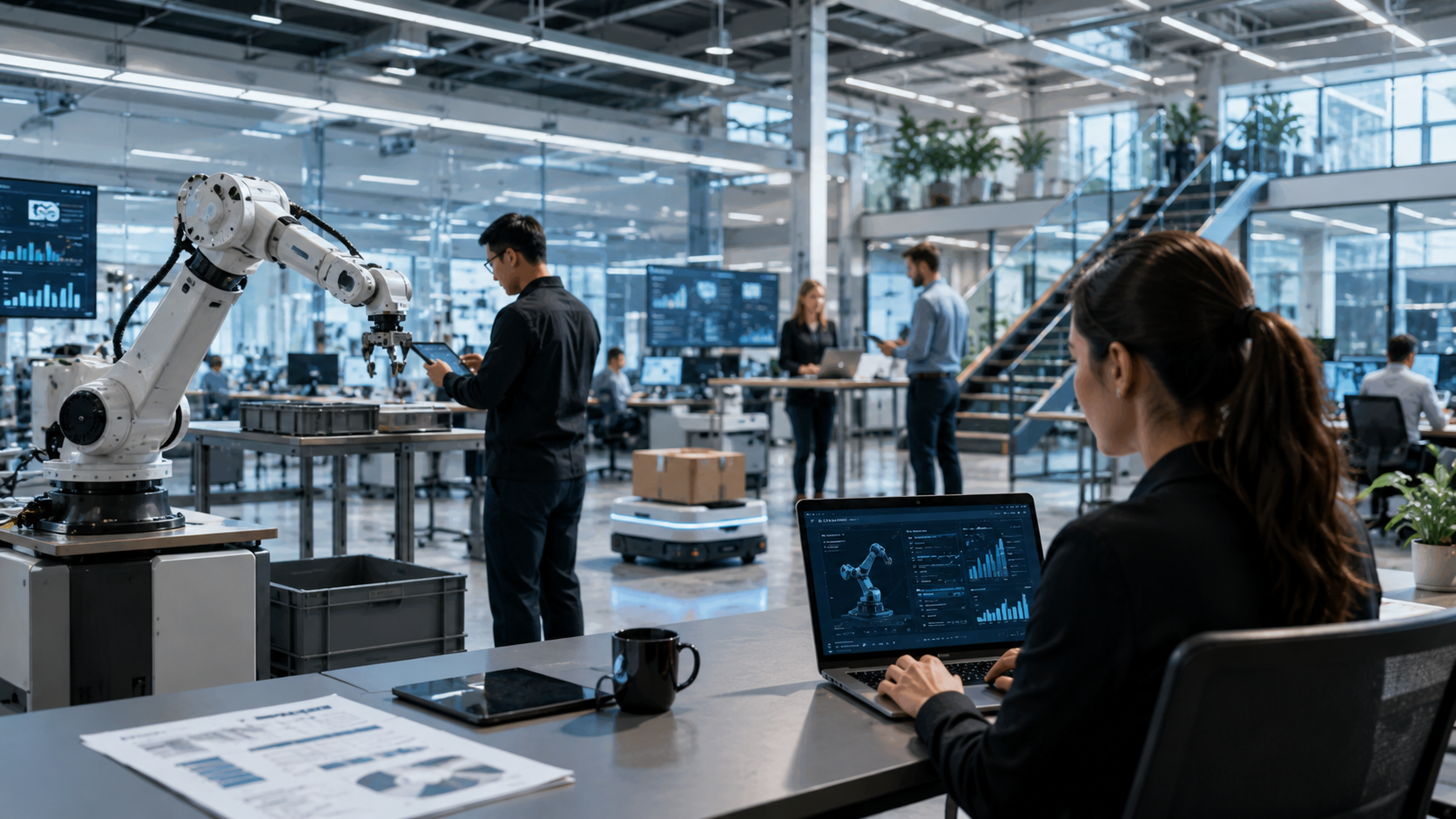
Learn how Robotics Automation is improving workplace productivity, efficiency, safety, and innovation across modern industries and businesses.
Robotics and Automation in the Modern Workplace
As industries continue to evolve, Robotics Automation is transforming how businesses operate, increasing productivity while improving efficiency and workplace safety. Organizations across manufacturing, healthcare, logistics, retail, and professional services are adopting automation technologies to streamline operations and remain competitive in a rapidly changing economy.
Rather than replacing human talent entirely, Robotics Automation is increasingly being used to support employees by handling repetitive, time-consuming, or hazardous tasks, allowing people to focus on higher-value work.
What Is Robotics Automation?
Robotics Automation combines robotic systems with intelligent software to perform tasks with minimal human intervention. These technologies can assemble products, transport materials, inspect quality, process information, and automate repetitive administrative activities.
Modern automation often integrates artificial intelligence, machine learning, sensors, and data analytics to improve accuracy and adapt to changing conditions.
Improving Workplace Productivity
One of the greatest benefits of Robotics Automation is increased productivity. Robots can operate continuously, perform repetitive tasks with consistent precision, and reduce production delays.
Businesses can complete more work in less time while maintaining high levels of quality and operational efficiency.
Enhancing Workplace Safety
Automation is especially valuable in environments where employees may be exposed to hazardous conditions. Robots can perform tasks involving heavy lifting, dangerous machinery, toxic materials, or extreme temperatures, reducing workplace injuries and improving overall safety.
By assigning high-risk activities to automated systems, organizations create safer working environments for their employees.
Supporting Manufacturing Excellence
Manufacturing remains one of the largest adopters of Robotics Automation. Automated production lines improve assembly speed, quality control, packaging, and inventory management while minimizing production errors.
Smart factories also use connected robotic systems to monitor equipment performance and optimize operations in real time.
Transforming Logistics and Warehousing
Warehouses and distribution centers increasingly rely on robotics to move inventory, sort packages, manage storage, and prepare customer orders. Automated systems help reduce delivery times, improve inventory accuracy, and support the growing demands of e-commerce.
These technologies enable businesses to respond more efficiently to customer expectations.
Automation Beyond Manufacturing
Today, Robotics Automation extends beyond industrial settings into finance, healthcare, retail, and customer service. Software robots can process invoices, manage payroll, schedule appointments, analyze documents, and respond to customer inquiries.
This broader adoption allows organizations to improve operational efficiency across multiple departments.
Working Alongside Employees
Automation is designed to complement human skills rather than replace them in many workplaces. Employees continue to provide creativity, critical thinking, problem-solving, emotional intelligence, and strategic decision-making, while robots manage repetitive or routine tasks.
This collaboration allows businesses to improve productivity while creating opportunities for employees to focus on more meaningful work.
Challenges of Implementation
Adopting Robotics Automation requires careful planning and investment. Businesses must evaluate technology costs, employee training, cybersecurity, system integration, and ongoing maintenance.
Organizations should also develop change management strategies that help employees adapt to new technologies and evolving job responsibilities.
The Future of Robotics Automation
Advancements in artificial intelligence, machine learning, cloud computing, and connected devices will continue expanding the capabilities of robotics. Future workplaces are expected to feature more intelligent, flexible, and collaborative robotic systems that support innovation across nearly every industry.
Businesses that invest strategically in automation will be better positioned to remain competitive in the digital economy.
Conclusion
Robotics Automation is reshaping the modern workplace by improving productivity, enhancing safety, reducing operational costs, and supporting business innovation. As technology continues to advance, automation will play an increasingly important role in helping organizations adapt to changing market demands.
By combining human expertise with intelligent automation, businesses can build more efficient operations, strengthen competitiveness, and create sustainable long-term growth in the future of work.
