
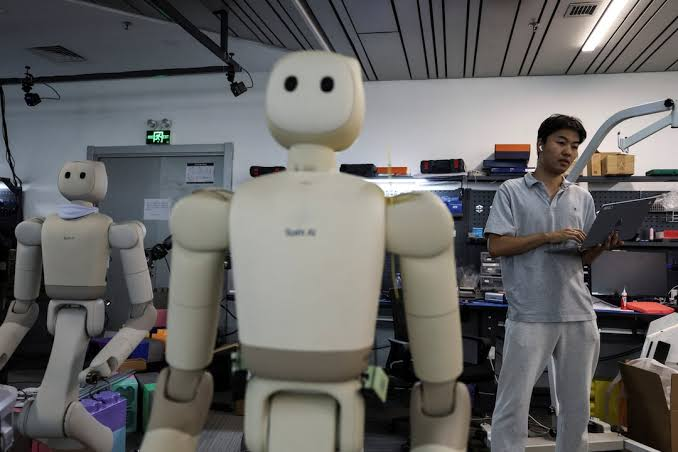
Humanoid robots have learned to run, dance and perform impressive demonstrations. The next challenge is much harder: making them intelligent enough to understand what people actually want them to do.
Chinese robotics startup Spirit AI believes the industry could reach a major milestone by mid-2027, when humanoid robots may be capable of receiving natural-language instructions and translating them into sequences of useful physical actions.
Gao Yang, Spirit AI's co-founder and chief scientist, told Reuters that the robotics industry is approaching what he describes as its equivalent of a “ChatGPT moment” — a software breakthrough capable of turning impressive machines into genuinely useful products.
The Biggest Robot Problem Is No Longer Just Hardware
Humanoid robot hardware has advanced rapidly.
Machines can increasingly walk over uneven terrain, maintain balance, manipulate objects and perform athletic demonstrations that would have appeared extraordinary only a few years ago.
But impressive movement does not necessarily equal intelligence.
A robot might be programmed to perform a specific dance perfectly while still being unable to understand a simple instruction such as:
“Open the refrigerator, find the bottle of water and bring it to me.”
That task requires the machine to understand language, identify objects, navigate an environment, manipulate different surfaces and react when something does not happen exactly as expected.
According to Gao, the robot's “brain” remains the weakest part of the robotics stack.
Spirit AI Is Targeting Mid-2027
Spirit AI expects to reach what Gao calls a GPT-3.0-level milestone for robotics by mid-2027.
The comparison is not meant to suggest that a humanoid robot will literally run GPT-3.
Instead, it describes a stage at which robot intelligence could become useful enough to trigger much broader adoption.
The goal is for a person to speak naturally to a robot and have the machine determine a reasonable sequence of physical actions needed to complete the request.
That would represent a substantial shift from today's highly scripted demonstrations.
Why ChatGPT Is the Comparison
Before ChatGPT launched publicly in 2022, artificial intelligence had already existed for decades.
But ChatGPT changed how ordinary people interacted with it.
Users no longer needed specialist knowledge or complicated software interfaces. They could simply type a request in everyday language.
Robotics companies want something similar.
Instead of programming every movement manually, users could eventually tell a machine what outcome they want.
The robot would determine the individual steps itself.
That transition could make humanoid robots accessible to factories, warehouses, retailers and eventually households.
Spirit AI Is Training Robots With Human Movement
Teaching robots how to operate in the physical world requires enormous amounts of data.
Spirit AI is taking a particularly hands-on approach.
The company employs roughly 1,000 contractors across China who use data-collection equipment while performing ordinary physical activities in homes and industrial environments.
The movements provide training information showing robots how humans interact with real objects.
At a Spirit AI training centre visited by Reuters, workers equipped with sensors repeatedly performed tasks including opening refrigerators, unlocking safes and cutting vegetables.
Those actions may appear simple to a human.
For a robot, they involve complex combinations of perception, force, balance, object recognition and planning.
Why Real-World Data Matters
AI language models learn largely from enormous collections of text, images and other digital information.
Robots face a different problem.
They need to understand physics.
A cup can slip. A drawer can become stuck. Fabric bends. Glass can break. A bag changes shape when lifted.
These physical properties are difficult to capture perfectly through simulation.
Spirit AI therefore focuses heavily on real-world training data rather than relying entirely on virtual environments.
The objective is to expose its AI systems to the messy unpredictability that robots encounter outside controlled demonstrations.
The Robots Already Have a 90% Success Rate on Simple Tasks
Spirit AI says its robots can achieve approximately a 90% success rate on simple tasks in structured living-room environments.
That sounds impressive, but the remaining 10% illustrates why household robotics remains difficult.
A robot working in a highly controlled factory can encounter the same objects in predictable locations repeatedly.
A home is different.
Someone moves a chair. Clothes are left on the floor. A child places a toy in a doorway. A glass is positioned differently from yesterday.
Humans adapt to those changes almost automatically.
Robots must calculate them.
Factories Could Get Useful Humanoid Robots First
Industrial environments are therefore expected to become one of the first major markets.
Gao believes the next one to two years could mark the initial deployment window for more capable humanoid robots in industrial applications.
Factories offer structured environments where tasks are repetitive and layouts can be designed around automation.
A humanoid form may also have an advantage.
Factories, warehouses and tools were originally designed for human bodies. A robot with arms, hands and roughly human proportions may be able to use existing infrastructure without requiring an entire facility to be rebuilt.
Spirit AI Robots Are Already Working on Production Lines
This is not entirely a future concept.
Spirit AI already has dozens of its Moz1 humanoid robots operating on production lines at CATL and JD.com, according to Reuters.
CATL is one of the world's largest battery manufacturers, while JD.com operates major logistics and e-commerce infrastructure.
Deployments in real commercial environments are particularly important because they reveal problems that controlled laboratory demonstrations can miss.
A robot that performs beautifully during a five-minute demonstration must still prove it can work reliably for thousands of hours.
Household Robots Will Take Longer
The dream of a humanoid robot cooking dinner, cleaning the house and handling everyday chores remains much more difficult.
Homes are unpredictable.
Objects are rarely placed in exactly the same position. Tasks change constantly. Humans and pets move around the environment.
Household objects are also extraordinarily diverse.
A robot may need to manipulate a soft towel one moment and a fragile glass the next.
Gao therefore expects useful industrial robots to arrive before genuinely capable general-purpose household machines.
China Is Racing Into Humanoid Robotics
Spirit AI is operating inside one of the world's most competitive robotics markets.
Chinese companies have demonstrated increasingly capable humanoid machines that can run, dance, perform backflips and participate in sporting demonstrations.
Earlier this month, Reuters highlighted China's Tiangong Ultra, which broke records at the World Humanoid Robot Games as engineers worked to translate athletic capability into practical applications.
The emphasis is now shifting from spectacular movement to economic usefulness.
The winning robot may not be the machine capable of performing the most impressive backflip.
It may be the one capable of working an eight-hour shift reliably.
Embodied AI Could Be the Next Major AI Market
The intelligence controlling physical machines is often called embodied AI.
Traditional generative AI processes digital information.
Embodied AI must connect intelligence to a physical body.
That creates a much larger challenge because actions have consequences in the real world.
A chatbot can generate an incorrect sentence and immediately try again.
A robot holding a glass, operating industrial equipment or moving around people cannot treat every mistake so casually.
Physical AI therefore requires sophisticated perception, planning and safety systems.
Safety Becomes More Important as Robots Get Smarter
More autonomous robots also introduce obvious safety questions.
A machine powerful enough to lift industrial equipment must recognise when a human has entered its path.
A household robot handling kitchen equipment must understand the difference between actions that are safe and those that could cause injury.
Spirit AI says its machines incorporate force-control mechanisms designed to limit potentially dangerous physical behaviour. Gao also acknowledged that safety concerns will become more important as robot intelligence improves.
Today's systems remain relatively immature.
But greater capability means greater responsibility.
Spirit AI Has Raised More Than $670 Million
The financial race behind humanoid robotics is accelerating alongside the technology.
Spirit AI has raised more than $670 million since 2024 and is valued at approximately $2.9 billion, according to Reuters.
That level of investment illustrates how seriously investors are taking embodied AI.
The potential market extends across manufacturing, warehousing, logistics, retail, healthcare and eventually consumer robotics.
If humanoid robots become genuinely useful general-purpose workers, the economic opportunity could be enormous.
The Next AI Revolution May Have Arms and Legs
Generative AI's first major breakthrough happened on screens.
People asked questions, generated images and wrote code.
The next phase may increasingly happen in the physical world.
AI models are being connected to cars, industrial machinery, scientific laboratories and humanoid robots.
That transition changes what artificial intelligence means.
Instead of merely providing information about what should happen, an AI system can potentially perform the action itself.
What Happens Next?
The crucial milestone will not be another carefully choreographed robot demonstration.
It will be reliability.
Can a humanoid receive a new instruction it has never encountered before, understand the objective, determine the necessary steps and successfully complete the task in an unpredictable environment?
Spirit AI believes meaningful progress towards that goal could arrive by mid-2027.
Whether the industry actually reaches that milestone on schedule remains uncertain.
But if humanoid robots do experience their own “ChatGPT moment,” the consequences could extend far beyond robotics.
ChatGPT demonstrated that artificial intelligence could communicate naturally with people.
The next breakthrough could demonstrate that AI can work alongside them in the physical world.